
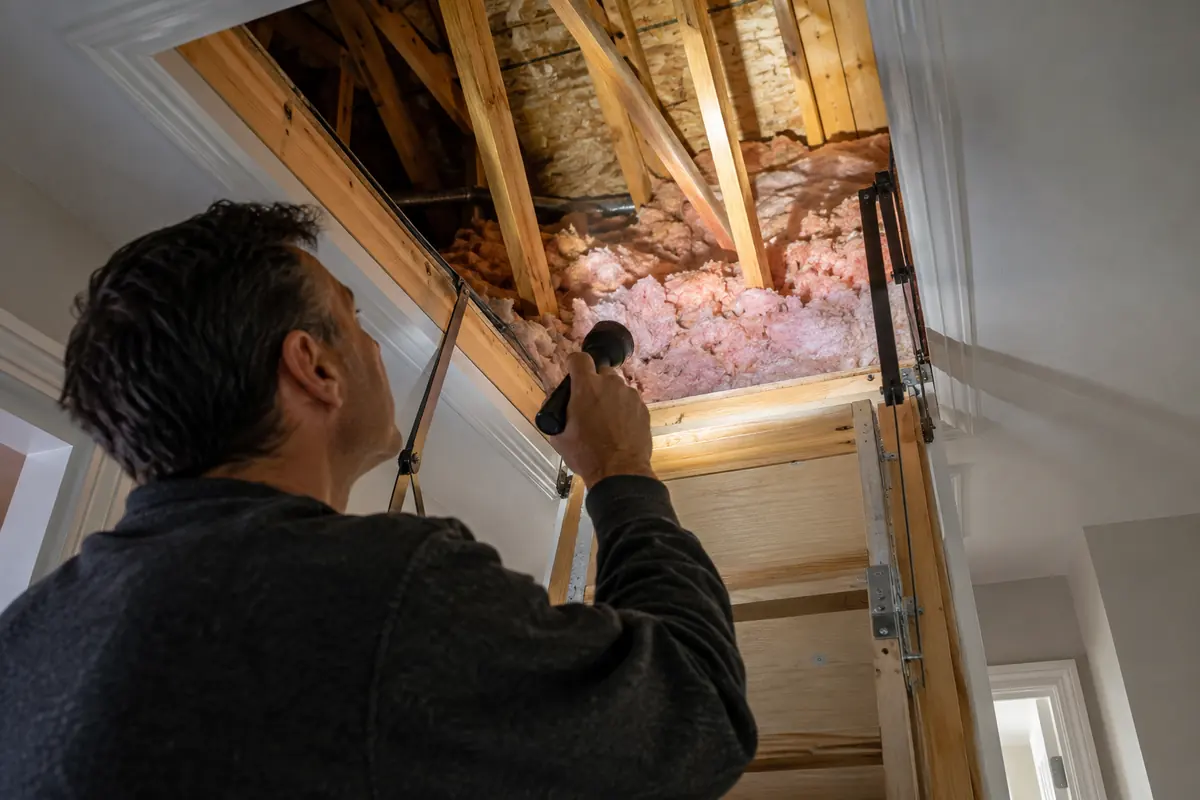
Start with the condition you see, then explore the question most closely related to your home. These answers are general and an on-site review may change the suitable scope.
Common questions
How can I tell whether I need a top-up?
Compare material condition, coverage, depth and roof-edge areas. Dry serviceable insulation may be suitable to retain; wet or heavily disturbed material needs another discussion.
Is blown-in insulation the same as cellulose?
No. Blown-in is an application method. Either loose-fill fibreglass or cellulose may be installed this way, according to product and project suitability.
Can new material be put over wet insulation?
The water source must be addressed first. Wet material and the assembly need assessment before deciding on drying, removal or replacement.
Does attic insulation stop drafts?
Ordinary insulation resists heat transfer but does not automatically seal gaps in the ceiling air barrier. Accessible leakage paths are a separate part of a scope.
Will more vents solve condensation?
Not automatically. Indoor moisture, exhaust routing, air leakage and roof-space ventilation can all contribute. A condition-based assessment matters.
What is an attic baffle?
A baffle helps keep an intended airflow path open at the eaves where insulation might otherwise block soffit intake.
How much insulation is enough?
R-value, existing insulation and the product-specific installed depth are more informative than inches alone. Program requirements and assembly details may also affect the target.
Can old insulation remain?
Sometimes. Its condition, compatibility and the need to reach leakage areas determine whether a top-up is reasonable.
Why is my room above the garage cold?
The garage ceiling, perimeter air leakage, exterior walls, windows and HVAC can each contribute. A room-specific assessment helps narrow the issue.
What happens if hazardous material is suspected?
Stop ordinary disturbance and seek an appropriately qualified assessment or specialized service. General insulation removal is not hazardous-material remediation.
Does a top-up qualify for an Ontario rebate?
Potential eligibility depends on the program route, existing R-value, target, participating contractor or assessment requirements, documentation and current terms.
Do I need a Milton permit for an attic top-up?
Requirements depend on actual scope. Do not infer a universal attic permit rule. Contact the Town of Milton when work includes regulated alterations.
What should I share in the form?
Provide affected rooms, existing insulation if known, attic access and any leak or renovation history. Photos are optional when safely available.
What changes the cost?
Area, access, removal, material, air sealing, baffles, hatch work, difficult areas and disposal all affect scope and price.
Is fibreglass always better than cellulose?
Neither material is universally best. Compare product instructions, installation quality, existing conditions and the actual attic assembly.